

You want to save money on flights in 2026. We get it. Airfare is unpredictable. But one thing is clear: the day you fly matters a lot. New data shows that Thursday is the cheapest day for international flights, with an average saving of 8%. And Wednesday is the overall winner for domestic trips. In this guide, we’ll break down the science, compare domestic vs international, and give you tools to find the best deals. Let’s get straight to it.
The Science Behind Cheap Flight Days
Airline pricing is driven by demand. When fewer people want to fly, prices drop. That’s simple economics. But why are some days cheaper than others? The answer lies in traveler behavior and airline inventory systems.
Business travelers usually fly Monday mornings and return Thursday or Friday. Leisure travelers prefer Friday to Sunday. That leaves Tuesday, Wednesday, and Thursday as lower-demand days. Airlines adjust prices to fill seats on these days. The result? You can save a lot by flying midweek.
In 2026, data from multiple sources confirms this pattern. by Skyscanner, Wednesday is the cheapest day to fly on average for both domestic and international routes. But a deeper look at international fares shows Thursday offering the biggest documented discount: 8% off the average ticket price. This comes from a report by Forbes Advisor (which analyzed Expedia data). Sunday, in contrast, is the most expensive day, with only 6% savings at best.
Why is Thursday cheaper? International flights often have a longer travel time, and business travelers avoid Thursday departures because they want to be home for the weekend. Leisure travelers also tend to return on Sunday or Monday. So Thursday becomes a sweet spot.
Domestically, the pattern is similar but not identical. Tuesday and Wednesday are consistently the cheapest days for U.S. flights. of Google Flights data, flying on Tuesday saves about 13% compared to weekend travel. Wednesday comes close.
But here’s the catch: the day you book also matters, but less than the day you fly. Booking on Tuesday or Wednesday is only about 1.3% cheaper than booking on Sunday. So don’t stress about the purchase date too much. Focus on your travel date.
Bottom line: Flying midweek , especially Tuesday, Wednesday, or Thursday , can save you 6% to 13% compared to weekend travel, with Thursday being the top pick for international trips.

“Flying midweek isn’t just a tip , it’s a data-backed strategy. The numbers don’t lie: Thursday saves you the most on international flights.”
Best Days to Fly: Domestic vs. International
The cheapest days to fly aren’t the same for every trip. Your destination matters. Let’s break it down.
Domestic Flights (within the U.S.)
For domestic travel, Tuesday and Wednesday are the clear winners. Why? Because most U.S. travelers fly on weekends or Mondays. Airlines know this, so they drop prices on slower days. A study by Google Flights (reported by CNET) found that travelers can save up to 13% by choosing Tuesday over Sunday.
Also, consider the time of day. Early morning or late-night flights , often called “red-eyes” , are cheaper. If you can handle a 6 a.m. departure or a midnight landing, you’ll pay less. But the biggest savings come from the day of the week.
International Flights
International routes follow a different pattern. Thursday stands out as the cheapest day to depart, with 8% average savings according to Forbes/Expedia data. Wednesday is also strong, especially for flights to Europe and Asia. Monday and Tuesday are generally cheaper than weekends, but not as good as midweek.
Why Thursday? For long-haul flights, airlines use sophisticated yield management. Thursdays often have less leisure demand and business demand is lower than Monday. Plus, many travelers return on Sundays, so Thursday departures align with shorter trips.
Regional differences exist. For flights to Mexico and the Caribbean, Wednesday is often cheapest. For Europe, Tuesday and Wednesday are solid. For Asia, Monday or Tuesday can work well.
Bottom line: Match your departure day to your destination type , Tuesday/Wednesday for domestic, Thursday for international , and you’ll consistently pay less.
How to Find the Cheapest Flight Days (Tools & Strategies)
Knowing the patterns is one thing. Actually finding those cheap days is another. Here are the tools and strategies we recommend.
1. Use a Price Comparison Engine
We might be biased, but Greenspicks is a great place to start. It aggregates real-time pricing from multiple providers so you can see the cheapest days at a glance. Just enter your route and use the flexible date view. You’ll see a grid of prices for the whole month.
2. Google Flights
Google Flights is a powerful free tool. Use the “Date grid” and “Price graph” features to spot the cheapest days. You can also set up price alerts. According to Google’s own data, flying on Tuesday can save 13% domestically. We covered this in more detail in our guide on cheapest flights: best day to book and fly.
3. Set Alerts on Multiple Platforms
Don’t rely on one tool. Set alerts on Greenspicks, Google Flights, and maybe Skyscanner. When prices drop, you’ll know. But remember: the day you fly matters more than the day you book. Our article on best days and times to book flights in 2026 explains this trade-off.
4. Be Flexible with Airports
Sometimes flying into a different airport can save hundreds. For example, flying into London Gatwick instead of Heathrow, or Long Beach instead of LAX. Use the flexible destination search on Greenspicks to compare.
5. Consider Connecting Flights
Nonstop flights are convenient but expensive. According to CNET (citing Google Flights data), flying with a layover can save up to 22%. If you have time, it’s worth it. But check the total travel time , a 12-hour layover isn’t fun.
If you’re booking last minute, our guide on last minute flight deals has specific strategies for getting cheap fares within a week of departure.
Bottom line: Use comparison tools, set alerts, and be flexible with dates and airports. The best tool is the one you use consistently.
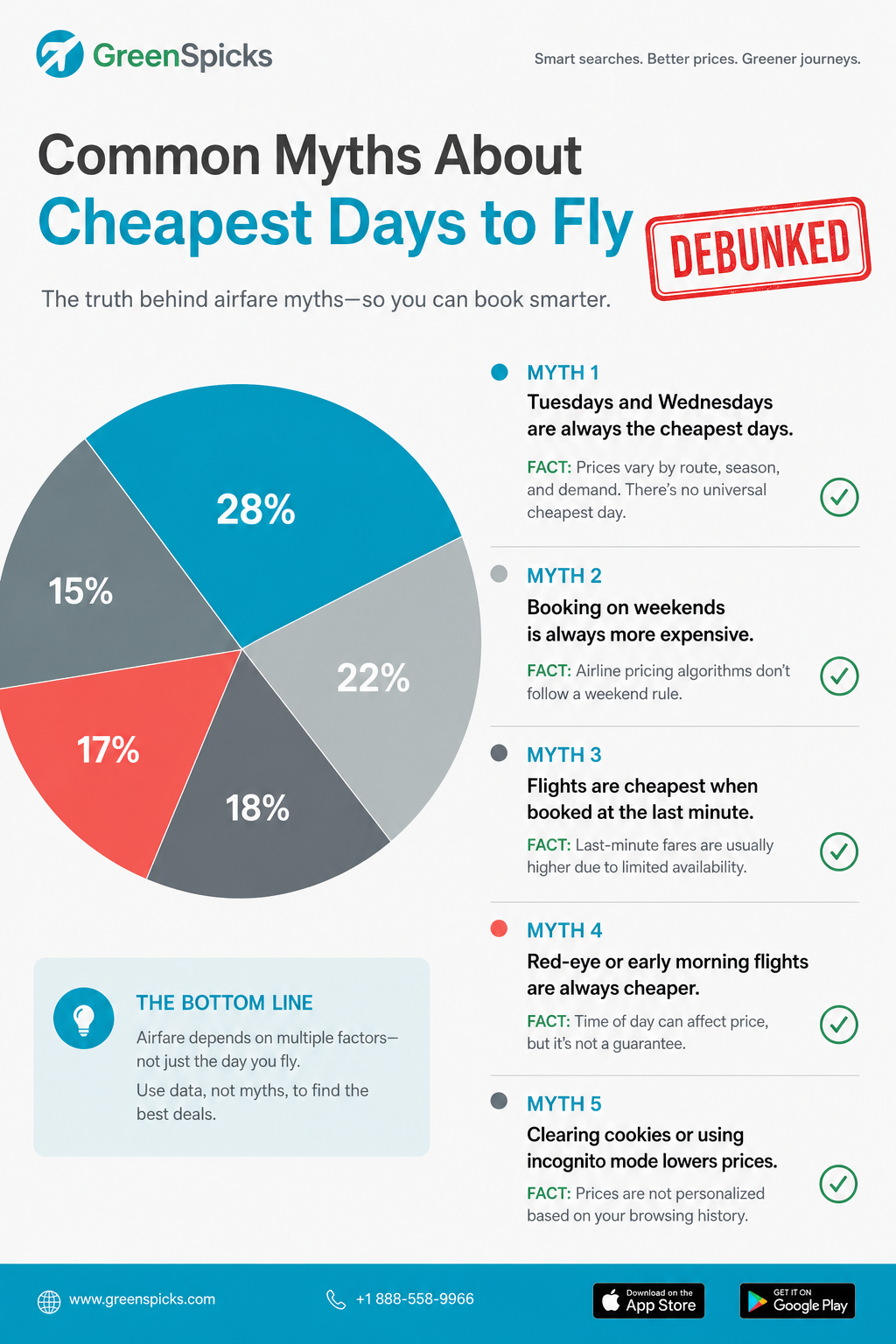
Common Myths About Cheap Flight Days
There’s a lot of bad advice out there. Let’s debunk the biggest myths about the cheapest days to fly.
Myth 1: Tuesday is always the cheapest day to fly.
Not true. While Tuesday is often cheap for domestic flights, Thursday is actually cheaper for international trips, with an 8% average saving. And Wednesday beats Tuesday on many routes. The “Tuesday myth” persists because of old data from when airlines released sales on Monday nights. Today, pricing is dynamic.
Myth 2: Booking on Tuesday at midnight gives you the best deal.
This is a legend. Airlines don’t release new prices at a specific hour across all time zones. The best time to book is when you see a price you’re comfortable with. Use alerts, don’t wait for midnight.
Myth 3: Flying on a holiday is a great deal.
Sometimes, but not always. For example, flying on Christmas Day itself can be cheap because no one wants to travel. But the days around it are expensive. Check specific dates rather than assuming.
Myth 4: Incognito mode gets you lower prices.
There’s little evidence that clearing cookies changes prices for flights. Airlines base prices on demand and inventory, not your browsing history. Save your energy for flexible date searches.
Myth 5: All airlines follow the same pricing pattern.
Budget airlines like Spirit or Frontier often have different patterns. They may have cheap Thursdays one week and cheap Saturdays the next. Always use a comparison tool to on cheap airline tickets covers how to compare across carriers.
In reality, the cheapest days to fly depend on route, season, and booking window. No single day works for every trip. But the midweek pattern (Tue, Wed, Thu) holds true broadly.
“Don’t fall for the Tuesday myth. The real data shows Thursday is the hidden gem for international flights.”
Bottom line: Be skeptical of one-size-fits-all advice. Test patterns for your specific route using real-time tools.
Frequently Asked Questions
What is the absolute cheapest day to fly in 2026?
There’s no single answer for all routes, but for domestic U.S. flights, Tuesday is consistently the cheapest day to fly, with Wednesday close behind. For international flights, Thursday offers the biggest documented savings , up to 8% on average according to Forbes/Expedia data. Always check your specific route because seasonal variations can shift patterns.
Is it cheaper to fly on Tuesday or Wednesday?
Both are cheap, but Wednesday slightly edges out Tuesday for domestic flights in many datasets. However, the difference is small , often less than $20. The key is to avoid Fridays and Sundays. If you are flexible, try both Tuesday and Wednesday and pick the lower fare. For international, Thursday beats both.
Are flights cheaper on Saturdays?
Yes, Saturday can be surprisingly affordable, especially for afternoon departures. Many leisure travelers fly out Friday and return Sunday, so Saturday sits in a lull. If you can fly out on Saturday and return midweek, you’ll often see big savings. Sunday is the most expensive day, so avoid it when possible.
Does the cheapest day to fly vary by airline?
Yes. Budget carriers like Spirit, Frontier, and Allegiant have dynamic pricing that can make any day cheap if demand is low. But overall, the midweek pattern holds. For full-service airlines, Monday and Tuesday are often cheapest for domestic, while Thursday and Wednesday are best for international. Use a comparison tool to see per-airline variations.
What about red-eye flights , are they cheaper?
Yes, red-eye flights (late night departures) are almost always cheaper, regardless of the day. Combining a red-eye with a midweek departure gives you double savings. For example, a Wednesday 11 p.m. flight can be dramatically cheaper than a Friday 2 p.m. flight. Just be prepared to sleep on the plane and adjust your schedule.
How far in advance should I book for the cheapest day?
For domestic flights, book 1-3 months ahead, with 39 days being the average sweet spot. For international trips, aim for 2-6 months ahead, and at least 50 days before departure. Peak seasons like summer and holidays require even earlier booking , up to 6 months out for international. The cheapest day to fly won’t help if you book too late.
Are there any tools that predict the cheapest days automatically?
Yes. Google Flights’ date grid and price graph are excellent. Greenspicks also offers flexible date views that show at-a-glance prices for a month. Additionally, Hopper’s app uses AI to recommend whether to wait or buy. But no tool is perfect , use multiple sources and set alerts for your specific route.
Conclusion & Next Steps
Finding the cheapest days to fly in 2026 isn’t about luck. It’s about understanding demand patterns, using the right tools, and being flexible. We’ve shown you that Tuesday, Wednesday, and Thursday are your best bets , with Thursday winning for international and Tuesday for domestic. Myths like the Tuesday midnight booking rule are just that: myths.
Now it’s time to take action. Start by searching your next trip on Greenspicks with flexible dates. Look for departures on Tuesday, Wednesday, or Thursday. Try red-eye times. Consider alternate airports. Set price alerts and monitor for a week. You’ll quickly see how much you can save.
Remember, the goal isn’t perfection. The goal is to stop overpaying. Even a 5% saving on a $500 ticket is $25. Over a year of trips, that adds up. Share these tips with friends , they’ll thank you. Happy travels!
For more resources, s on best booking times and last-minute deals. And if you’re a content creator looking to share these insights, tools like Velio’s AI-driven YouTube growth hacks can help you turn this article into engaging video content. For social media promotion, consider a social media management dashboard to schedule your tips efficiently. Travel marketers can also benefit from Everest’s digital marketing services to amplify their reach.